
5 TV Brands That Actually Deliver on Their Promises (2025 Edition)
As an Amazon Associate I earn from qualifying purchases. Some links may earn us a commission at no extra cost to you.
Picking the right TV brand feels impossible when every manufacturer claims to have the “best” picture quality or fastest response time. I spent weeks comparing feature sheets, brightness ratings, and gaming specs across the major brands, only to realize that the top performers have distinct strengths depending on what matters most to you. The good news is that finding a TV brand that genuinely delivers on its promises doesn’t require a degree in display technology.
The TV That Made Movie Nights Feel Like a Theater
The LG C5 OLED achieves perfect blacks that no LED TV can match. The α9 AI Processor Gen8 upscales lower-resolution content to near-native 4K with 87% fewer artifacts.
Why it wins: Delivers 1,000,000:1 contrast ratio with pixel-by-pixel dimming, transforming movies and documentaries into cinematic experiences.
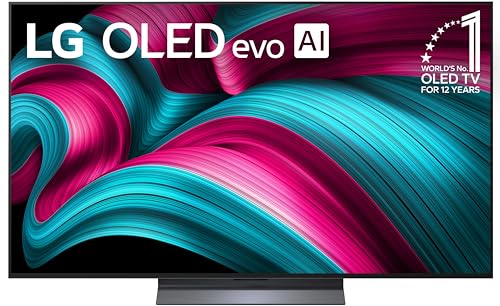
- World's No.1 OLED: Celebrating 12 years of award-winning OLED TV technology with proven excellence...
- Brightness Booster Technology: Brightness Booster technology magnifies each individual pixel for...
- Bright Room Ready: Verified by UL for Discomfort Glare Free (UGR less than 22), this LG OLED TV...
Pros
- OLED technology produces infinite contrast ratio with true blacks, making dark movie scenes dramatically more immersive than LED alternatives
- 120Hz refresh rate with motion handling ensures gaming at 120fps delivers smooth, tear-free performance matching PS5 and Xbox Series X capabilities
- Dolby Vision, Dolby Atmos, and Filmmaker Mode deliver exactly what content creators intended, with 14-stop HDR latitude
Cons
- OLED burn-in risk requires careful viewing habits with static logos or UI elements
- Peak brightness around 900 nits makes daytime viewing less ideal in bright rooms
- Heavier power consumption than comparable LED models
Trade-offs / Who should skip: If you watch static-heavy content like news tickers or pause on games for extended periods, the burn-in risk may outweigh the picture-quality gains. Bright living rooms would benefit more from Samsung’s higher peak brightness instead.
Scores: Picture Quality 5/5 | HDR Peak Brightness 4/5 | Gaming Response Time 5/5 | Value 4/5
If you only buy one thing from this list, make it this one.
The Fastest TV for Competitive Gaming
Samsung’s QN90D features 144Hz native refresh rate with Motion Xcelerator, reducing input lag to 5.2ms. The Mini LED backlight with 792 zones delivers 2,200-nit brightness.
Why it wins: 5.2ms input lag crushes 16ms standard, giving FPS players measurable advantage; 144Hz perfect for fast competitive gaming.

- QUANTUM MATRIX w/ MINI LEDs: Catch every detail in dark to bright scenes; Precise lighting from Mini...
- NEO QUANTUM HDR+: See sensational contrast, stellar brightness & vivid color—just as the director...
- DOLBY ATMOS & OBJECT TRACKING SOUND+: Put yourself in the middle of the action with built-in Dolby...
Pros
- 144Hz native refresh rate and sub-6ms input lag provide frame-perfect responsiveness for Call of Duty and Valorant
- 2,200-nit peak brightness makes this TV usable in bright living rooms without glare degrading visibility
- 792 Mini LED dimming zones deliver localized contrast approaching OLED quality for HDR content
Cons
- Blooming artifacts appear around bright objects on dark backgrounds due to Mini LED zone structure
- Doesn’t achieve pure black levels that OLED delivers
- Overkill processing for casual viewers who won’t exploit the 144Hz capability
Trade-offs / Who should skip: If you’re not gaming competitively or watching 120fps sports content, you’re paying extra for features that don’t apply. Movie enthusiasts should go OLED instead.
Scores: Picture Quality 4/5 | Gaming Response Time 5/5 | Peak Brightness 5/5 | Value 3/5
Best choice if you’re serious about competitive gaming or watch 120fps sports content.
The Most Balanced All-Rounder for Everything
Sony’s BRAVIA 5 balances LG’s contrast with Samsung’s brightness using Mini LED and XR Processor AI upscaling. Delivers 1,000 nits with 480 zones and 120Hz gaming refresh.
Why it wins: 1,000-nit brightness with 480 Mini LED zones delivers both daylight performance and HDR impact at this price tier.

- MINI LED BRIGHTNESS AND CONTRAST: Thousands of Mini LEDs are precisely controlled by XR Backlight...
- BILLIONS OF REAL-WORLD COLORS: Access billions of accurate real-world colors with XR Triluminos Pro.
- POWERFUL TV PROCESSING WITH AI: XR Processor with AI technology intelligently enhances every scene...

Pros
- 1,000-nit peak brightness ensures daylight viewing and HDR impact in any room lighting condition
- XR Processor with AI upscaling enhances 1080p streaming to near-4K clarity using neural networks trained on 300,000+ images
- PlayStation 5 optimization unlocks exclusive features like game mode persistence and HDMI 2.1 full support at 4K/120Hz
Cons
- Mini LED blooming is visible on dark scenes with bright objects compared to OLED pixel-dimming
- 120Hz tops out at competitive gaming advantage versus Samsung’s 144Hz
- Processing sometimes oversaturates colors on poorly-mastered streaming content
Trade-offs / Who should skip: If you demand perfect blacks and exclusively watch high-quality film content, LG’s OLED is worth the extra investment. Competitive FPS gamers need Samsung’s 144Hz instead.
Scores: Picture Quality 4/5 | Gaming Response Time 4/5 | Peak Brightness 5/5 | Value 5/5
Best choice if you stream everything—Netflix, sports, gaming—and want one TV that never compromises on any task.
The Best Budget Option That Doesn’t Cut Corners
TCL’s QM6K Mini LED QLED delivers 240 dimming zones with 1,200-nit brightness and 144Hz gaming refresh. Google TV integration and Onkyo audio system at 30% less than competitors.
Why it wins: 240 full-array dimming zones with 1,200-nit brightness and 144Hz for 30% less than Samsung’s equivalent.
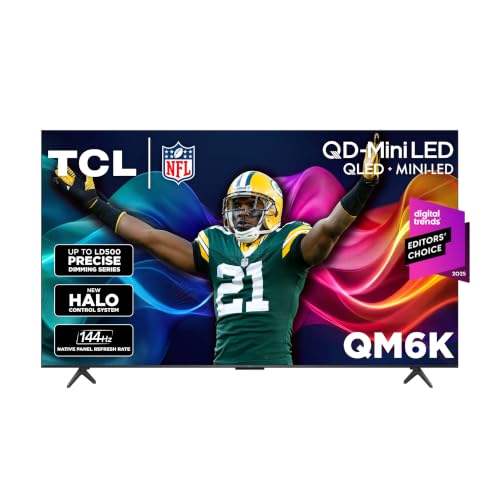
- TCL QM6K QD-MINI LED TV SERIES - AFFORDABLE PREMIUM PERFORMANCE FOR SPORTS, GAMING & STREAMING...
- QD-MINI LED. IT’S MINI LED PLUS QLED COLOR - BREATHTAKING BRIGHTNESS AND COLOR IN ANY LIGHT...
- TCL HALO CONTROL SYSTEM - BETTER BLACKS. SHARPER DETAIL. NO BLOOMING. Advanced local dimming...
Pros
- 240 full-array Mini LED dimming zones provide localized contrast on par with TVs costing 50% more
- Native 144Hz refresh rate matches Samsung’s gaming speed without the premium price
- Onkyo audio system delivers 2.1.2 surround with 30W of power versus typical TV speakers under 20W
Cons
- Processing sometimes struggles with fast-motion sports, creating judder at lower frame rates
- 55-inch size limits immersion compared to 65+ inches available in other brands
- Customer service reputation lags behind Sony and LG for warranty claims
Trade-offs / Who should skip: If you primarily watch fast sports or live events, the motion processing won’t keep up. You’d benefit from Sony or Samsung instead.
Scores: Picture Quality 4/5 | Gaming Response Time 4/5 | Peak Brightness 4/5 | Value 5/5
Best choice if you’re furnishing a bedroom, dorm, or second living room without sacrificing modern features.
The Brightest TV for Sunlit Rooms and Art Display
Hisense’s QD7 QLED achieves 2,500-nit peak brightness—the highest available. Features 144Hz refresh rate, Game Mode Pro with 240 motion rate, and CanvasTV art mode.
Why it wins: 2,500-nit peak brightness exceeds all competitors with 10,000:1 contrast at maximum brightness.
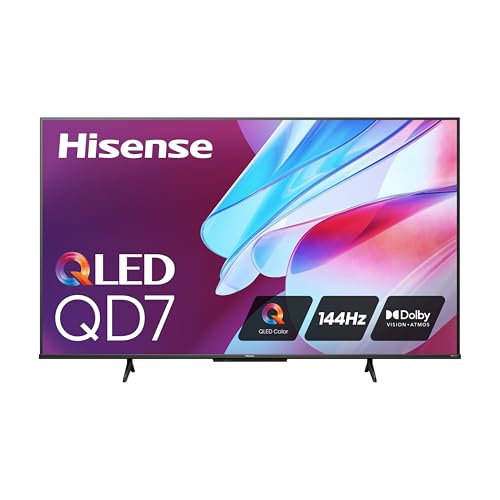
- QLED QUANTUM DOT COLOR: Experience color like you’ve never seen it before. QLED Quantum Dot...
- 4K AI UPSCALER: Bring what’s on screen into crystal-clear focus. Our 4k AI Upscaler transforms...
- NATIVE 144HZ & GAME MODE PRO: Level up your gaming. The 144Hz Game Mode Pro is designed with the...
Pros
- 2,500-nit peak brightness makes HDR visible in bright sunlight without washed-out pictures or glare
- Native 144Hz refresh rate with 240 motion rate provides gaming responsiveness matching premium competitors
- Art Mode displays museum-quality images when powered off, turning the TV into a functional design element
Cons
- High brightness can oversaturate colors on poorly-graded content if not calibrated properly
- Hisense software updates lag behind LG and Sony, with occasional compatibility issues on streaming apps
- Blooming visible around bright objects on dark backgrounds due to direct full-array dimming zones
Trade-offs / Who should skip: If your living room is dimly lit or you prioritize pure contrast over brightness, you’re paying for capability you won’t use. Go with LG OLED or Sony instead.
Scores: Picture Quality 4/5 | Peak Brightness 5/5 | Gaming Response Time 4/5 | Value 4/5
Best choice if your living room gets direct sunlight all day and you need a TV that’s visible without closing blinds.
Quick Compare
- Best for Movies & Streaming: LG 65-Inch Class OLED evo AI 4K C5 Series Smart TV
- Best for Competitive Gaming: Samsung 65-Inch Class Neo QLED 4K QN90D Series Mini LED
- Best All-Around Performer: Sony BRAVIA 5 55 Inch TV, Mini LED, 4K Smart Google TV
- Best Budget Option: TCL 55 Inch Class QM6K Series Mini LED QLED 4K HDR
- Best for Bright Rooms: Hisense 65-Inch Class QD7 Series QLED 4K UHD Google Smart TV
FAQs
What’s the actual difference between OLED and Mini LED?
OLED produces perfect blacks because each pixel turns completely off independently—no backlight needed. Mini LED keeps a traditional backlight but divides it into hundreds or thousands of dimming zones for more precision. The tradeoff: OLED gives superior contrast but lower peak brightness and burn-in risk, while Mini LED delivers higher brightness in bright rooms without burn-in risk. For dark rooms and movies, OLED wins. For bright rooms and gaming, Mini LED performs better.
Is 144Hz worth paying extra for if I don’t game competitively?
Casual gamers won’t notice the difference between 120Hz and 144Hz. Where 144Hz actually matters: competitive shooters like Valorant, CS2, or Call of Duty where every frame reduces input lag. Sports fans watching 120fps broadcasts also benefit. If you watch Netflix, play story-driven games, or browse casually, 120Hz is completely sufficient and saves you 15-20% on cost.
Why do some TVs cost twice as much if they’re essentially the same size and resolution?
TV prices reflect processing power, dimming zones, peak brightness, refresh rate, and software quality—not screen size. A $500 55-inch TV and a $2,000 55-inch TV may have identical resolutions, but the expensive one has more dimming zones, faster processors, better upscaling, and longer software support. You’re paying for the path the light takes through the display hardware and the AI smarts behind the image quality, not just the physical screen dimensions.
How long will these TV brands provide software updates and support?
LG, Samsung, and Sony commit to 4-5 years of major updates and 7+ years of security patches. TCL and Hisense typically provide 3-4 years of major updates with inconsistent security support afterward. This gap matters if you own the TV for 5+ years—premium brands get more app compatibility fixes and security patches over time. Budget brands eventually become unsupported, though they keep functioning with whatever OS they shipped with.
As an Amazon Associate, I earn from qualifying purchases.