
Best Crash Pad for Bouldering and Why Foam Density Is the Whole Product
As an Amazon Associate I earn from qualifying purchases. Some links may earn us a commission at no extra cost to you.
A bouldering pad is not a thick soft mat, and the difference is the thing that protects your ankles. A proper pad is layered: a thin firm closed-cell sheet on top that spreads the load across the whole surface, over a thicker soft open-cell layer underneath that absorbs the energy. Land on a single soft foam mat instead and your foot punches through to the ground, or worse, one edge compresses more than the other and your ankle rolls as you touch down. This matters here because a search for bouldering pads returns gymnastics mats, sensory mats for children and folding exercise mats, and the single best selling item it returns is a two inch exercise mat bought eight thousand times a month. So I score these on whether the construction is built to absorb a real fall.
Top picks
Metolius Session II Crash Pad — Best overall
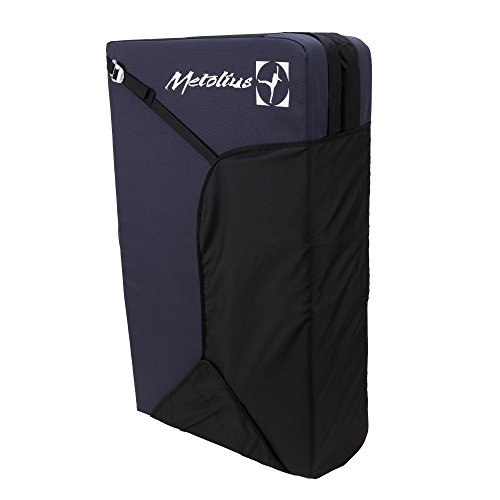
- Session II Crash Pad-Black Gray
- Session II Crash Pad-Black Gray
- Metolius
Why it wins: A hinged pad from one of the oldest names in American climbing, with the largest review base of any genuine bouldering pad in this search. Metolius has been making these since the sport had a name, and the Session sits at the size most people actually want: big enough for a standard landing, small enough to carry to the boulder without resenting it.
Pros
- Largest owner base among purpose-built climbing pads here
- Layered foam construction rather than a single soft slab
- Hinge design folds flat without a gap down the middle
- Long-standing climbing brand with parts and repairs available
Cons
- One pad rarely covers a real landing on its own
- Hinged pads leave a soft line where the fold sits
- Carry system is adequate rather than comfortable over distance
- Small review base in absolute terms, as the whole category has
Social proof: See rating and reviews on Amazon.
Trade-offs and who should skip: The safe default from a brand that knows the sport. Skip it if you need to cover a wide or broken landing on your own. Skip it if you walk far to your boulders.
Scores: Performance 5/5 | Fall absorption 5/5 | Ease of use 4/5 | Value 4/5
Metolius Recon Pad — Best for bigger falls
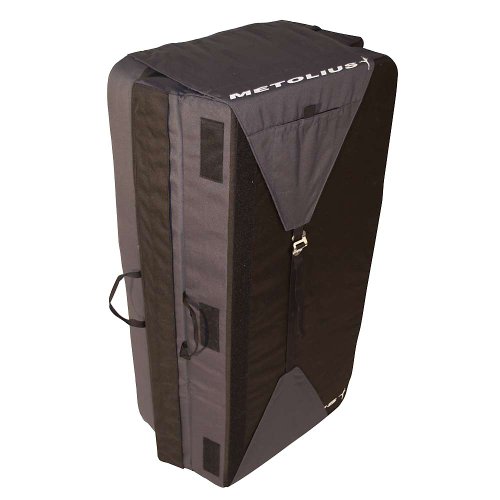
- RECON CRASHPAD-Black Gray
- RECON CRASHPAD-Black Gray
- Metolius
Why it wins: More foam and more area than the Session, which is what changes as problems get taller. Fall energy rises with height, and a pad that is fine for a sit start becomes marginal from the top of a highball, so the extra thickness is buying you margin at exactly the point you need it.
Pros
- Thicker and larger landing area than the standard pad
- Same established brand and construction quality
- Suits taller problems where a thin pad bottoms out
Cons
- Heavier and bulkier to carry to the rock
- Most expensive Metolius option here
- Overkill for low traverses and indoor use
- Very small review base
Social proof: See rating and reviews on Amazon.
Trade-offs and who should skip: More margin for taller problems. Skip it if you boulder low and walk a long way. Skip it if storage space at home is tight.
Scores: Performance 5/5 | Fall absorption 5/5 | Ease of use 3/5 | Value 3/5
Asana Hero Crash Pad — Best construction on paper

- PROFESSIONAL-GRADE FALL PROTECTION: Designed for outdoor bouldering, the Hero Crash Pad uses a...
- CONSISTENT, STABLE LANDING PLATFORM: Dual-density construction helps prevent bottoming out while...
- BUILT FOR HEAVY OUTDOOR USE: Constructed with a 1680D ballistic nylon shell and a durable 1000D...
Why it wins: Triple-layer dual-density foam in a 1680 denier nylon shell, made in the United States, and the listing states the construction plainly rather than saying thick. That transparency is unusual here and it is the specification that matters: the layering, not the total depth, is what stops you bottoming out.
Pros
- States the foam layering rather than only the thickness
- Heavy denier shell resists the abrasion that kills cheap pads
- Made in the United States with repairs available
- Full suspension carry system rather than two straps
Cons
- Almost no reviews, so nothing to check the claims against
- Costs more than the better known brands
- 48 by 36 inches is a modest landing on its own
- Newer to the market than Metolius
Social proof: See rating and reviews on Amazon.
Trade-offs and who should skip: The best described pad here, with the least evidence behind it. Skip it if you want a track record. Skip it if you need the largest landing per pound spent.
Scores: Performance 4/5 | Fall absorption 5/5 | Ease of use 4/5 | Value 3/5
Meister Boulder Beast XL — Biggest landing area

- Oversized tri-fold bouldering crash pad designed to provide superior cushioning for falls and the...
- Each panel features four layers of premium open and closed cell foam for 5” of total padding...
- Removable backpack straps with waist belt and chest strap make it easy to carry the Beast to the...
Why it wins: Seventy two by forty four inches of tri-fold pad with five inches of multi-layer cushioning, which is a genuinely large landing for one purchase. Coverage is the thing beginners underestimate: falls do not land where you plan, and a wider pad forgives a step back that a small one punishes.
Pros
- Largest landing area on this page by a clear margin
- Five inches of layered foam rather than a single thickness
- Shoe cleaning carpet panel built into the flap
- Highest average rating here, on a small base
Cons
- Tri-fold designs create two soft seams across the landing
- Bulky and heavy to carry any real distance, on a small review base for a safety product
- Not a specialist climbing brand
Social proof: See rating and reviews on Amazon.
Trade-offs and who should skip: Coverage bought at the cost of portability. Skip it if you hike to your boulders. Skip it if you would rather have two smaller pads to arrange.
Scores: Performance 4/5 | Fall absorption 4/5 | Ease of use 3/5 | Value 5/5
Asana VersaPad — Best second pad
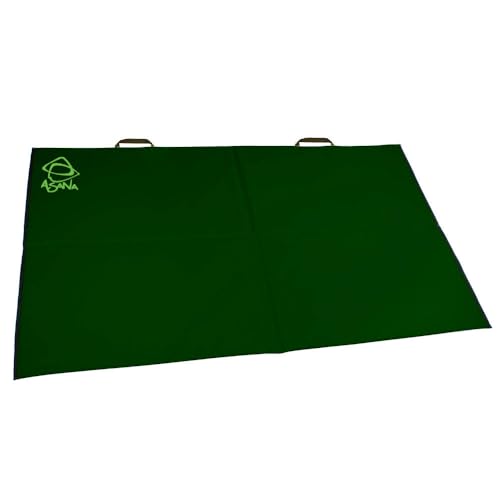
- VERSATILE DESIGN: The VersaPad Crash Pad (formally known as the Pro Spotter) revolutionizes the way...
- SIT START PAD: First of all the pad can be, in its most traditional sense, a sit start pad. Filled...
- GAP COVER: Unfold the VersaPad to its full size and discover its true magic. This pad is...
Why it wins: A 74 by 44 inch supplemental pad, one inch thick, made to lie across the seam between two full pads and turn a broken landing into a continuous one. Gaps are where ankles go over, so the cheapest real safety upgrade after your first pad is not a second full pad but something that covers the join, and this unrolls over it in seconds.
Pros
- Covers the gaps that a pair of pads always leaves
- Doubles as a sit start pad and a shoe-changing surface
- Rolls up small and adds little weight to the carry
- Made in the United States alongside the full-size Asana pads
Cons
- One inch is a gap filler rather than a landing on its own
- Very small review base, as the whole category has
- Only worth buying once you own a full pad
Social proof: See rating and reviews on Amazon.
Trade-offs and who should skip: The upgrade that fixes the weak point in a pad setup. Skip it if you only own one pad and no seams to cover. Skip it if you need primary protection first.
Scores: Performance 4/5 | Fall absorption 3/5 | Ease of use 5/5 | Value 5/5
Quick compare
- Best overall: Metolius Session II, one pad is rarely enough
- For highballs: Metolius Recon, heavy to carry
- Best described: Asana Hero, barely any reviews
- Largest landing: Meister Boulder Beast XL, two fold seams
- Best second pad: Asana VersaPad, a gap filler rather than a landing
Two things worth knowing before you spend. Judge these on construction rather than star count, because every genuine climbing pad here has fewer than a hundred reviews while the gym mats that share the search results have thousands, and the numbers are not comparing like with like. Look for a firm closed-cell top layer over a softer core, stated plainly, and you are most of the way to a good pad. And a pad reduces injury rather than preventing it. Pads do not cover a whole landing, they slide apart when you overlap them, and the gaps between them are where ankles break, so a spotter whose job is moving the pad and steering your torso is worth more than a second pad. If you are learning, practise falling before you practise falling from height.
As an Amazon Associate, I earn from qualifying purchases.