
Best Groundhog Deterrents (that actually work)
As an Amazon Associate I earn from qualifying purchases. Some links may earn us a commission at no extra cost to you.
If woodchucks (groundhogs) are tunneling under fences or sampling your garden buffet, the most reliable fixes are physical barriers and smart scare devices—then repellents as a supporting layer. Pay attention to mesh size, bury depth, coverage, and (crucially) your state’s wildlife rules.
Top picks
Dig Defence Drive-In Ground Panels (10″ depth, 32″ wide) — Best for stopping dig-unders fast
A permanent, no-trench barrier you drive along fence lines and gates to block burrowing.
Why it wins: Heavy, galvanized 4-gauge rods stop diggers where they try—at the fence line—without trenching.
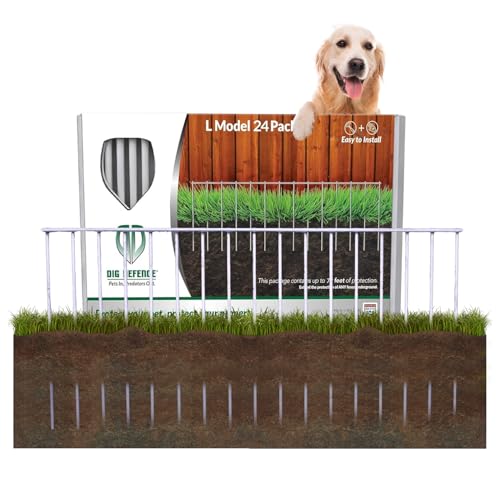
- The Original Animal Barrier Fence - Our animal fence barrier makes sure that your pets are securely...
- No dig fence barrier - An ergonomic and hassle-free garden fencing for dogs and other...
- High-quality protection - Manufactured in the USA and made with galvanized American steel, this...
Pros
-
4-gauge, fully-galvanized steel
-
Works with existing fences/gates
-
No trenching; hammer in panels
-
Scales quickly along long runs
Cons
-
Heavy; mallet or driver helps
-
Not ideal in rocky soils
-
May need multiple packs
Trade-offs / Who should skip
Great for fence lines. For stand-alone garden beds with no fence, a buried hardware-cloth skirt (pick 4) is better. For deep, active burrows under sheds, pair with an L-footer approach and bury ~10–12 inches.
Scores: Performance 5/5 · Burrow blocking 5/5 · Ease of Use 3/5 · Value 4/5
Havahart Critter Ridder Granular (2 lb shaker) — Best for light, non-structural deterrence
Label-backed, pepper-based granules you shake around beds, doors, or burrow areas.
Why it wins: Repels by odor/taste and is OMRI-listed for organic use; reapply per label.
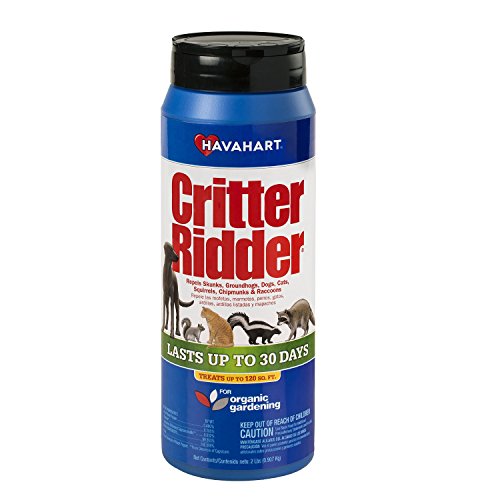
- Repels by taste and odor - not offensive to humans
- Proven to repel cats, dogs, chipmunks, groundhogs, squirrels and skunks
- Contains oil of black pepper, piperine and capsaicin
Pros
-
OMRI-listed; odor/taste repellent
-
Label includes groundhogs
-
Easy perimeter applications
Cons
-
Reapply after heavy rain
-
Works best with exclusion
-
May struggle amid abundant food
Trade-offs / Who should skip
Best as a supporting layer. For persistent animals or active burrows, choose physical exclusion (picks 1 or 4) first.
Scores: Performance 3.5/5 · Longevity per application 3.5/5 · Ease of Use 4.5/5 · Value 4/5
Orbit Yard Enforcer (model 62100) — Best motion-activated sprinkler
A PIR-sensing sprinkler that bursts water when it detects movement—effective conditioning for daylight-active groundhogs.
Why it wins: Wide, chainable coverage with adjustable sensitivity and a 30-minute watering mode.
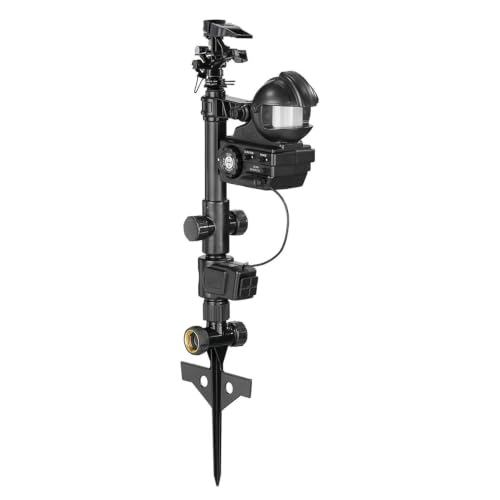
- Humane Lawn & Garden Protection - Help protect lawns, gardens, flower beds, and landscaping from...
- Heat & Motion Animal Detection - Using passive infrared sensing technology, the Yard Enforcer...
- Day, Night & Always-On Operation - Choose from Day, Night, or Always-On modes to help tailor...

Pros
-
Motion bursts condition repeat visitors
-
Large, expandable coverage
-
Adjustable sensitivity & timer
Cons
-
Needs hose and water pressure
-
May startle pets/guests
-
Winterize to avoid freeze damage
Trade-offs / Who should skip
Excellent for open lawns and garden perimeters. If entry happens under fences, go straight to dig barriers (pick 1) or buried mesh (pick 4).
Scores: Performance 4.5/5 · Coverage area 4.5/5 · Ease of Use 4/5 · Value 4/5
Yardgard 1/2″ Hardware Cloth, 19-ga, 36″x50′ (308200B) — Best for classic buried fence skirts
A durable, galvanized 1/2″ mesh roll for L-footers around beds, sheds, decks, and stand-alone gardens.
Why it wins: Matches common best-practice installs—bury ~10–12″ and bend the bottom outward to stop burrowing.
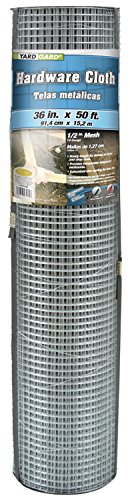
- Use to cover window and screen doors, tree guards, drains, gutters, under eaves, soil sifters, and...
- Uniformly welded for security and stability
- Galvanized after product provides extra durability
Pros
-
1/2″ mesh blocks digging and chewing
-
Galvanized; long service life
-
Works for beds, decks, sheds
Cons
-
Trenching and time required
-
Gate thresholds need attention
-
Utilitarian look
Social proof
See reviews on Amazon.
Trade-offs / Who should skip
The most permanent standalone fix—but more labor. If you already have a fence and want speed, the drive-in panels (pick 1) are easier to install.
Scores: Performance 4.5/5 · Burrow resistance 5/5 · Ease of Use 2.5/5 · Value 4.5/5
Havahart 1079 Large 1-Door Trap (32″x10″x12″) — Best for legal, humane capture when required
A time-tested live trap sized for groundhogs—use only where trapping and next steps are legal.
Why it wins: Purpose-built dimensions with smoothed edges; arrives assembled and ready.

- HUMANE CAPTURE: This large live animal trap safely captures raccoons, cats, possums, and other small...
- HEAVY-DUTY CONSTRUCTION: Built with galvanized wire mesh and solid steel door, this raccoon trap...
- SAFETY FIRST: Features smooth internal edges to prevent animal injuries and protective handle guards...
Pros
-
Sized for groundhogs; sturdy build
-
Smoothed interior edges
-
Ships fully assembled
Cons
-
Relocation often illegal—verify first
-
Non-target capture risk
-
Requires daily checks
Trade-offs / Who should skip
Use only when you have a clear, legal plan post-capture. In many cases, exclusion (picks 1 & 4) is both simpler and more humane.
Scores: Performance 4/5 · Handling & release safety 4/5 · Ease of Use 3.5/5 · Value 4/5
Quick compare
-
Pick 1 — Best for dig-unders: heavy, galvanized panels you drive in; heavier install kit needed.
-
Pick 2 — Best for light deterrence: OMRI-listed granular repellent; reapply after rain.
-
Pick 3 — Best for open yards: motion sprinkler with wide coverage; needs hose/PSI.
-
Pick 4 — Best for stand-alone beds/sheds: buried 1/2″ mesh L-footer; more labor upfront.
-
Pick 5 — Best when trapping is required: large, humane live trap; check state rules first.
Buying guide
Start with exclusion. For gardens and under-structure burrows, the most durable fix is a fence/mesh installed per best practice: 3–4 ft above ground, bury ~10–12″ with the bottom 6–12″ bent outward in an L-shape to foil tunneling. Pair a fence with drive-in panels along gates and gaps for fast reinforcement.
Use motion deterrents to condition behavior. A motion-activated sprinkler can keep day-timers like groundhogs out of open spaces while plants establish, especially when combined with fencing.
Repellents are supporting players. Pepper-based repellents labeled for groundhogs can help, but they require reapplication and won’t overcome easy access to food.
Mind the calendar and the law. Young are typically present spring to early summer; eviction/exclusion is most humane once young are independent. Trapping and relocating wildlife is illegal in many states—know your local rules or hire a licensed operator.
FAQs
Q: What mesh should I use, and how deep should I bury it?
A: Use 1/2″ hardware cloth (or ≤2″ woven wire for fences). Bury ~10–12″ and bend the bottom outward 6–12″ to create an L-footer, then secure gates as well.
Q: Do ultrasonic stakes work on groundhogs?
A: Couldn’t verify strong, independent evidence. Exclusion, motion sprinklers, and habitat tweaks outperform ultrasonics.
Q: When is it safe to seal a burrow?
A: Aim for mid- to late-summer after young are independent.
Q: Is relocating a trapped groundhog legal?
A: Often not. Many states restrict or prohibit translocation; check your wildlife agency before you set a trap.
As an Amazon Associate, I earn from qualifying purchases.