
Best Solar Phone Chargers
As an Amazon Associate I earn from qualifying purchases. Some links may earn us a commission at no extra cost to you.
If you’re off-grid—even for a few hours—what matters most is real USB output in sun, panel size/weight, and smart features like auto-restart and a stand/ammeter so you can aim the panel. Integrated batteries are handy for clouds, but solar trickle is slow; the most reliable setup is a folding panel → power bank → phone.
How I researched
I compared late-2025 roundups, deep-dive reviews, and maker manuals, prioritized measured USB output in sun, port mix (USB-C vs USB-A), weight/packability, and auto-restart/aiming behavior. I checked compatibility (5V USB charging), noted warranty/support, and whether panels were panel-only vs. integrated battery. I weighed charging speed, reliability in variable light, durability (fabrics/ETFE), and ownership costs.
Top picks
BigBlue SolarPowa 28 — Best for backpacking & all-around phone charging
A proven 28W folder that just works: light, efficient, and easy to aim thanks to a built-in ammeter.
Why it wins: Consistently good 5V output with auto-restart; sensible size/weight.

- Superior Sunlight Harvesting: BigBlue portable solar panel boasts premium, high-efficiency solar...
- Intelligent Fast Charging Ports: Equipped with dual high-speed ports featuring an intelligent chip...
- Real-Time Power Monitoring & Ultimate Portability: Conveniently track energy generation with the...
Pros
-
Built-in ammeter helps you aim fast
-
Auto-restart handles passing clouds
-
Folds small; trail-friendly weight
-
Simple, durable fabric enclosure
Cons
-
US version is USB-A only
-
No built-in stand; needs props
Social proof
Owner feedback consistently highlights dependable charging and the ammeter’s usefulness.
Trade-offs / Who should skip
If you need USB-C PD out, look at SunJack below or use an A-to-C cable. Panel is panel-only—pair it with a power bank for best results.
Scores: Performance 4.5/5 · Charging reliability 4.5/5 · Ease of Use 4.5/5 · Value 4.5/5
Nekteck 28W Solar Charger — Best budget folder
Straightforward 28W panel with two USB-A ports that resumes charging after shade.
Why it wins: Solid output for the money and auto-resume behavior at this price.

- 【High Efficiency Solar Panel】 Nekteck solar panels charger are equipped with superior Maxeon...
- 【Double USB-A Ports】The USB solar panel charger has max (5V) 2.4A output per port, total...
- 【Portable Camping Solar Panel】Portable solar panel adopts IPX4 waterproof technology, which is...
Pros
-
Light, slim, easy to pack
-
Auto-resume after brief shade
-
Simple two-port layout
-
Good entry-price option
Cons
-
USB-A only; no USB-C
-
Couldn’t verify exact weight
Social proof
Owners praise the “set-and-forget” behavior in good sun.
Trade-offs / Who should skip
If you want a sturdier fabric or USB-C out, consider SunJack. For an integrated battery, see BioLite.
Scores: Performance 4/5 · Charging reliability 4/5 · Ease of Use 4/5 · Value 4.5/5
BioLite SolarPanel 10+ — Best for parks, picnics & “set it down” charging
Compact 10W panel with integrated 3,200 mAh battery, kickstand, and a sundial for easy aiming.
Why it wins: Built-in battery smooths clouds; setup is idiot-proof.

- Access smart energy from the sun with the SolarPanel 10+; Get 10 watt output to power tablets...
- Features BioLite's patented Optimal Sun System to simplify setup and maximize solar power; Analog...
- Kit includes the SolarPanel 10+, USB cable and instructions; Folds down to a compact and portable...
Pros
-
Battery buffers shade, charges later
-
Sundial makes aiming simple
-
Handy 360° kickstand
-
Compact, commuter-friendly
Cons
-
Slower than 20–28W folders
-
Battery capacity is modest
Social proof
Generally positive for convenience and ease; output suits phones and headlamps. See reviews on Amazon.
Trade-offs / Who should skip
Not ideal for power-hungry tablets or multiple devices. Choose a 20–28W folder if speed matters.
Scores: Performance 3.5/5 · Charging reliability 4.5/5 · Ease of Use 5/5 · Value 4/5
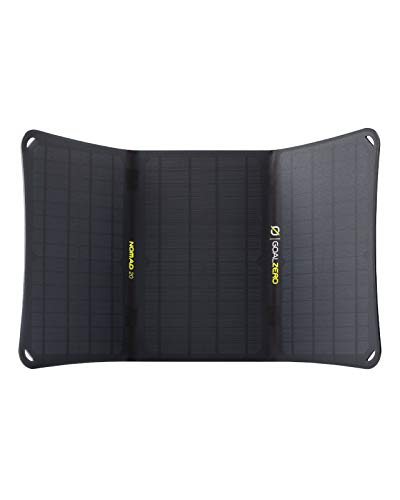
Goal Zero Nomad 10 — Best for durability & brand ecosystem
A tough 10W panel with a built-in kickstand and USB-A out—great with Goal Zero Flip/Venture banks.
Why it wins: Reliable build, clear specs, and excellent support/warranty.
Pros
-
Rugged fabric and stitching
-
Kickstand set to multiple angles
-
Clear, transparent specs
-
Strong support/warranty
Cons
-
10W is modest for phones
-
USB-A only output
Social proof
Well-liked for build quality and brand support; steady performer in sun.
Trade-offs / Who should skip
If you want faster phone charging, the 20–28W panels above are better. Stick with Nomad 10 if you value durability and the Goal Zero ecosystem.
Scores: Performance 3.5/5 · Charging reliability 4/5 · Ease of Use 4.5/5 · Value 3.5/5
SunJack 25W ETFE Panel — Best rugged USB-C + USB-A
A tough ETFE-coated 25W folder with USB-C (5V/3A) and USB-A (5V/3A) and compact folded size.
Why it wins: Rare to get USB-C out plus ETFE durability at this size.

- Engineered with durable ETFE and IP67 waterproof rating, this rugged panel thrives in all...
- Compact foldable design collapses to the size of a tablet for easy packing, making it the ultimate...
- High-efficiency monocrystalline cell and smart IC chip tech deliver maximum output via USB-A and...
Pros
-
True USB-C 5V/3A output
-
ETFE face resists wear
-
Auto-resume behavior noted
-
Good balance of size/power
Cons
-
Heavier than ultra-light 10W
-
Panel is panel-only (kit optional)
Social proof
Owners call out durable fabric/coating and dependable USB-C.
Trade-offs / Who should skip
If every ounce counts, 10W panels are lighter. If you want a built-in battery, BioLite is simpler.
Scores: Performance 4.5/5 · Charging reliability 4.5/5 · Ease of Use 4/5 · Value 4/5
Quick compare
-
BigBlue SolarPowa 28 — Best for backpacking: Strong 5V output, ammeter, auto-restart; USB-A only (US).
-
Nekteck 28W — Best budget: Two USB-A ports, panel-only with auto-resume; basic but effective.
-
BioLite SolarPanel 10+ — Best for parks: 10W with 3,200 mAh battery, kickstand & sundial; slower, super easy.
-
Goal Zero Nomad 10 — Best durable: 10W with kickstand and clear 5V/1.5A spec; rugged and supported.
-
SunJack 25W ETFE — Best rugged USB-C: 25W with USB-C & USB-A, ETFE face; a bit heavier than 10W.
Buying guide
- Pick wattage by expectation. For phones, 20–28W panels keep a power bank topped and will charge a single phone at reasonable speed in sun. 10W panels are fine for leisurely days but slower.
- Use a power bank as your buffer. Clouds and trees kill charging. The most reliable workflow is panel → power bank → phone. Integrated-battery panels (BioLite) help, but capacity is modest.
- Ports & cables. If you want direct USB-C out, shortlist SunJack; otherwise, USB-A panels plus a quality A-to-C cable work. BigBlue’s US version is 2×USB-A; some regions add a USB-C port.
- Aiming matters. Panels with kickstands/sundials/ammeter help you hit peak output fast (BioLite’s sundial, BigBlue’s ammeter, Goal Zero’s kickstand).
- Durability. ETFE-coated faces (SunJack) and tough fabrics (Goal Zero/BigBlue) hold up better to abrasion/UV over time.
- Warranty & support. Goal Zero publishes a strong 2-year warranty on Nomad 10; SunJack and other brands list warranty terms—always worth a glance if support matters to you.
- A note on “solar power banks.” Many power banks with tiny built-in panels charge very slowly from sun; treat their solar input as emergency backup, not your primary plan.
FAQs
Q: Can I charge my phone directly from a panel?
A: Yes, but performance varies with sun. For consistent results, run the panel into a power bank, then charge your phone.
Q: Do these need special cables?
A: No—standard USB-A or USB-C cables that match your phone. If your panel lacks USB-C, use a good A-to-C cable.
Q: Will a 10W panel charge a tablet?
A: It can trickle a tablet in strong sun but will be slow. Use a 20–28W panel for better results.
Q: Are these waterproof?
A: Panels tolerate light weather, but keep electronics and ports dry. Check each brand’s page for specific ratings.
As an Amazon Associate, I earn from qualifying purchases.